
Franklin County Criminal Docket Searches
There is no single portal. Franklin County splits its criminal docket between two public systems. Picking the wrong one wastes a search. For municipal misdemeanors, preliminary felony proceedings, and related municipal criminal matters, begin with the Franklin County Municipal Court Clerk CASE Network. A Franklin County Common Pleas felony case instead belongs in the Franklin County Clerk's Case Information Online, called CIO. Choose the court first, then the name field.
Each channel searches differently. The CASE Network accepts a case number, a ticket number, both first and last names, or a company name. The Municipal Clerk calls the number route the most efficient. Include the letters on any Franklin County ticket number. CIO allows a name search with a court selection. It also takes a full case-number search built from year, case type, and sequence number. Keep your citation, notice, or prior order close. It names the court and shows the format.
- Read the court named on the citation, arraignment notice, or prior docket entry.
- Use CASE Network for a Municipal Court case, or select Criminal in CIO for a Common Pleas case.
- Enter the exact case or ticket number when known. Otherwise, use the name fields and the correct court.
- Open the matching result and compare the case number, current setting, and court with the paper notice.
- Contact the responsible clerk for filed documents, older material, or an official certified copy.
Note: A public case-information result helps you locate the matter. The clerk still keeps the official court record.
Franklin County Criminal Docket Handoff
A felony here can leave footprints in two places. Franklin County Municipal Court takes the initial arraignment and preliminary stage. Once a grand jury indicts, the case ordinarily moves to the Franklin County Court of Common Pleas General Division. CIO is the public reader there. So a missing result in one system proves nothing about whether the charge ended. It may simply sit at the other court level.
The municipal path typically runs from filing or arrest to arraignment. From there it moves through plea or bond activity, judge assignment, a pretrial or trial setting, and disposition or enforcement. Municipal Court treats an accepted not-guilty plea in absentia from authorized counsel as a route to Assignment. Judge selection and a court date normally follow within one business day. After the indictment handoff, Common Pleas carries the case under its own court record. The issuing court plus the most recent Franklin County docket entry tell you where to look next.
Local process: Franklin County Municipal filing → arraignment or preliminary hearing → indictment when applicable → Franklin County Common Pleas criminal docket → plea or trial → disposition.
Criminal Dockets: What They Show
Think of a Franklin County criminal court docket as a timeline. It is not a copy of every paper in the file. A public view identifies the case and court. It names the Franklin County case category, lists docket activity in time order, and helps you spot settings and a disposition. Labels and detail vary by system. Read the live case entry instead of assuming each Franklin County division shows every charge, document image, financial item, or redaction the same way.
| Case number | CIO uses year, type, and sequence components. A criminal example uses the CR case type; CASE Network uses its own year, code, and sequence format. |
|---|---|
| Court and parties | These identify the division that owns the file and the case caption or named parties. |
| Docket events | Chronological filings, actions, entries, and prior or current settings appear as the court records activity. |
| Setting | An arraignment, pretrial, hearing, trial, plea, sentencing, or enforcement event may be listed with date and court context. |
| Disposition | The recorded end or result should be read using the court’s exact wording and confirmed with the clerk when an official record is needed. |
A docket date is not always the filing date. The Franklin County Clerk’s acceptance of a filing and the court calendar process are separate steps. For a hearing date, check the latest setting in the applicable court channel rather than trusting an older notice.
Franklin County Criminal Docket Codes
CIO sorts court records with local case-type codes. In the official Franklin County list, CR means Criminal and MI means Criminal Miscellaneous. The year and sequence stay part of the full number. A code can narrow a known Common Pleas case. It cannot replace the exact case number printed on a Franklin County court document.
- Arraignment
- An early criminal or traffic hearing where a plea and initial procedural actions occur.
- Preliminary hearing
- A Municipal Court stage that can precede a felony indictment in Common Pleas.
- Bond forfeiture
- A bond-related outcome that may lead to later enforcement activity on the docket.
- Enforcement docket
- A Municipal Clerk docket for ordered fines, costs, bond forfeiture, or a failure to begin ordered jail time.
Municipal case numbers use their own criminal code series, separate from the two-letter types CIO uses. Never reformat a number mid-search. Type it exactly as the citation, notice, or Franklin County Clerk format gives it.
Note: A code narrows you to the right system. The complete case number confirms the particular criminal file.
Criminal Case Stages on the Docket
A Franklin County criminal docket lists settings. A setting is a step in the process. It is not a forecast of how the case ends. A Municipal Court file might move from arraignment through bond activity, an assigned judge, and a pretrial. Then comes a plea, trial, or sentencing event. Out-of-jail criminal and OVI arraignments in Franklin County sit in room 4C. In-custody arraignments use room 4D. Those room numbers make the daily arraignment reports easier to scan. But the individual case record still controls what happens on any future date.
Once an indictment issues, Common Pleas case searching runs through Franklin County CIO. A CIO entry may show the criminal type code and later case activity. The earlier Municipal file stays separate in that court. A pending case can also show a court date without every document in the file being visible. For the current schedule, rely on the case docket and the right calendar channel for that court.
Franklin County Criminal Assignment Dates
The Municipal Court Assignment Office creates one common point of confusion in a Franklin County criminal docket search. After counsel enters a not-guilty plea in absentia, the Clerk sends the file to Assignment. That office handles judge selection and a court-date assignment, usually within one business day. So a plea can appear on the record before the next setting does.
Calling will not speed that up. The Municipal Criminal/Traffic Department states plainly that it cannot reschedule a hearing by telephone. Read the newest docket entry first. Then contact the court through its designated channel with the case number handy. The Franklin County daily arraignment reports can point to the listed courtroom for an arraignment. A later entry in the individual case always governs.
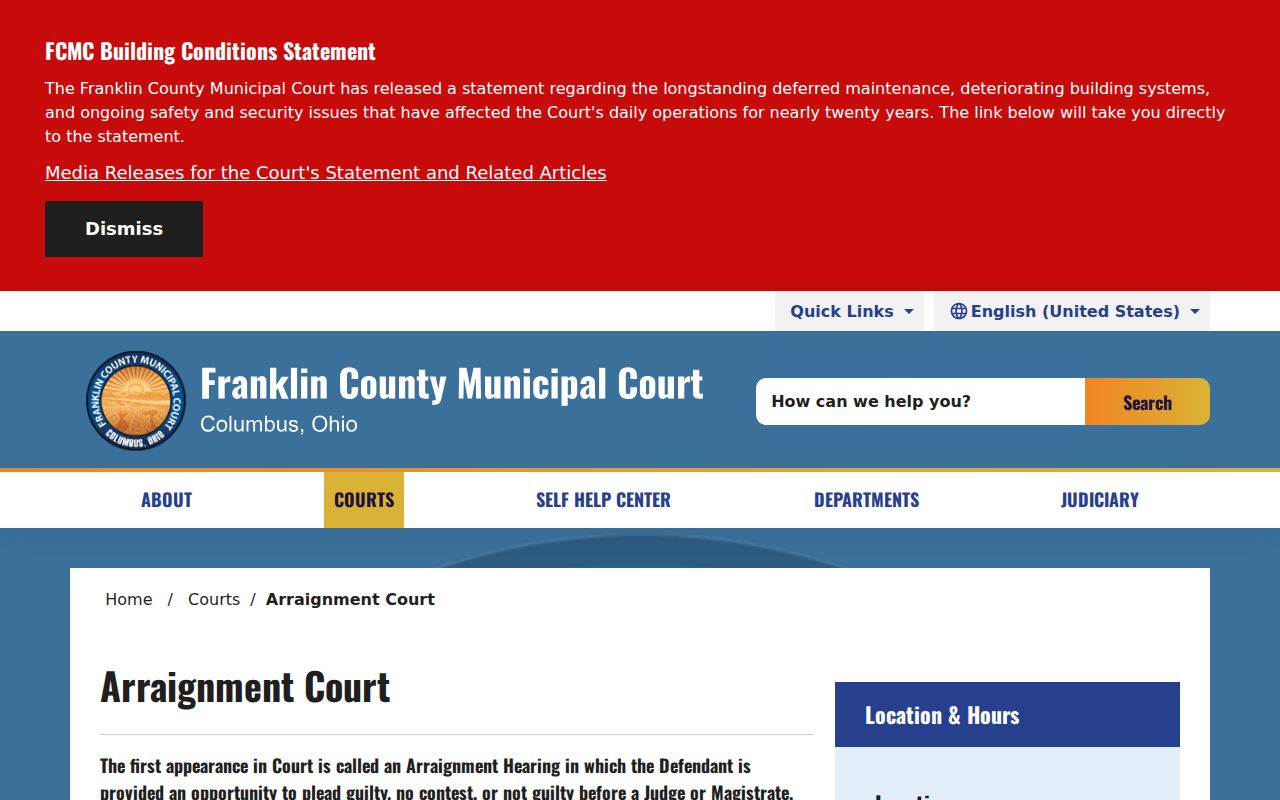
Municipal Court publishes its arraignment information by courtroom and hearing process.
Franklin County Criminal Docket Courts
Felony cases in Franklin County belong to the Franklin County Court of Common Pleas General Division. That court holds original jurisdiction over them. Its criminal records flow through Franklin County CIO and the Clerk of Courts Legal Division. Municipal Court runs a separate docket on CASE Network. That system covers misdemeanors, preliminary felony matters, traffic matters requiring an appearance, and environmental cases. Each court keeps its own clerk structure and record channel.
Mayor's Courts offer a third local path. They handle qualifying city ordinance, traffic, and misdemeanor matters. A case there may transfer when jurisdiction or procedure requires it. Start with whichever court is printed on the citation or summons. A shared county name does not put every matter into the Common Pleas or Municipal system. The same goes for a Columbus mailing address.
Note: Trust the court printed on the case papers. It beats a general county or city name for routing a search.
Franklin County Criminal Docket Reports
The daily Municipal arraignment reports serve one narrow purpose in a Franklin County criminal docket check. They confirm a day and courtroom. Entries are grouped by date and courtroom. Courtroom 4C covers out-of-jail criminal and OVI arraignments. Courtroom 4D handles in-custody arraignments. After you identify the case, the report helps you find that session fast. The CASE Network record still controls the current setting. So does any later court assignment.
Treat a report as a companion to the case number and the latest docket entry. It is never a substitute. Finding an arraignment session on a report tells you nothing. A later pretrial, plea, trial, or sentencing setting may have moved. For a Common Pleas felony after indictment, Franklin County CIO becomes the public route. So check each Franklin County court's own record at every stage. Do not carry one early result forward.
Franklin County Criminal File Access
Online case information is only one channel into a Franklin County file. For Municipal criminal and traffic matters, the Criminal/Traffic Department sits on the second floor at 375 S. High Street. Staff there can find a pending court date with the proper case number at 614-645-8186. It will not run an open-ended, multi-hour records search over the phone. For broader searches, the clerk directs people to a mailed request or a supervisor submission. Common Pleas criminal and records help comes from the Clerk Legal Division at 345 S. High Street, floor 1. That office answers at 614-525-3600.
The Franklin County Clerk public-records hub covers specific requests, inspection, copies, email or fax where offered, and mailed copies with postage. No written form is required. No stated purpose is required either. Naming the court, case number, and document sharply speeds retrieval. Transcripts and depositions work differently. The Clerk's policy sends parties and their representatives to the court reporter who created them.
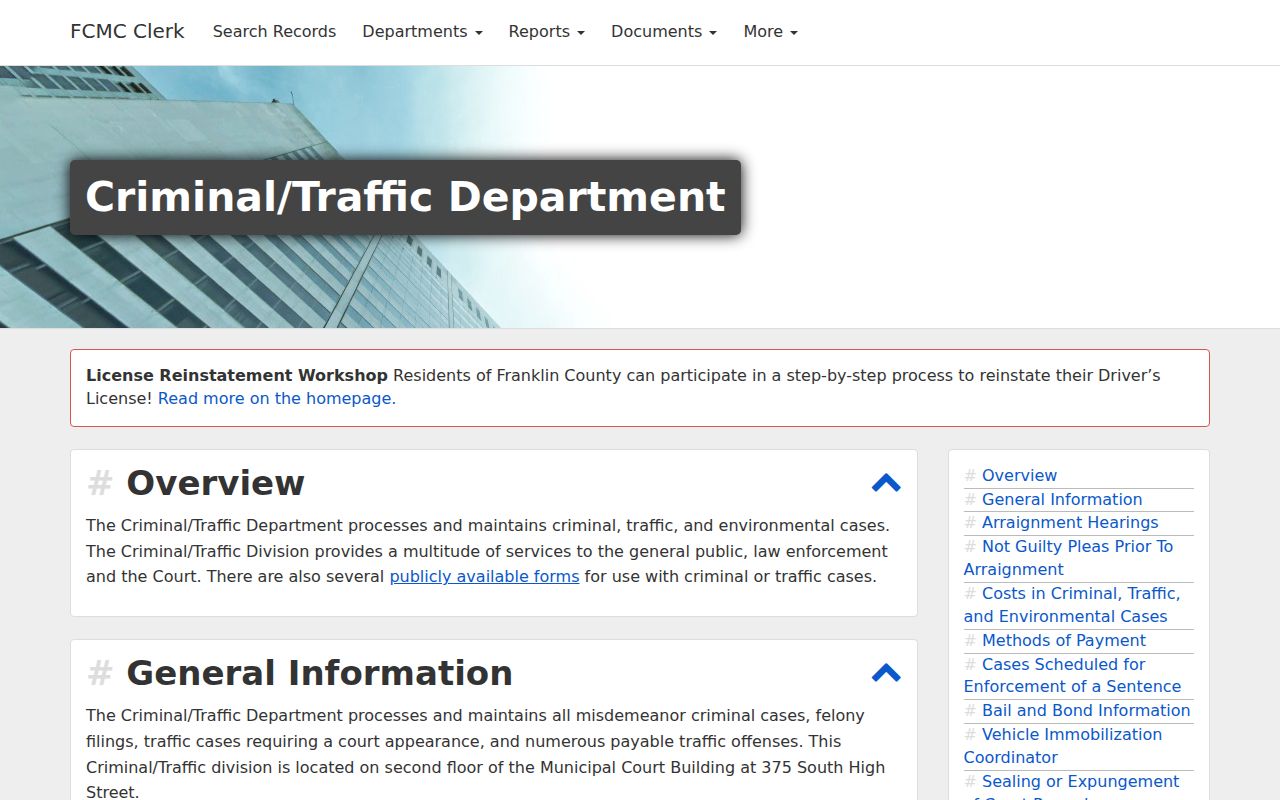
The Municipal Clerk’s Criminal/Traffic Department identifies its hearing and record-access channels.
Note: An online result is not a certified record.
Access Rules for Criminal Dockets
Public access is the default for Franklin County court records. The rules do carve out exceptions. Protected identifiers can be withheld under Clerk policy. So can confidential material and certain restricted Franklin County case types. So what does a missing online result mean for a criminal docket search? Almost anything. The cause could be the wrong court channel or a fresh filing. It could also be a restricted record, an older file, routine maintenance, or a sealing or expungement order. Treat an absent name with caution. The gap alone proves nothing about why the person is missing from the court docket.
Key rules:
Ohio Sup.R. 44–47 provides the public-access framework for court records and its exclusions.
Ohio Revised Code §2953.32 governs specified conviction and bail-forfeiture sealing or expungement records and related exceptions.
Ohio Revised Code §2953.33 supplies a separate route for certain dismissed, not-guilty, no-bill, or pardon outcomes.
Juvenile and protected records face extra limits beyond the ordinary rules. If the Clerk withholds or redacts a record you properly requested, the public-record policy requires that the legal authority be explained to you. For a definitive answer on any court record, verify it directly with the court or clerk that maintains the file.