
Franklin County Civil Docket Searches
Civil filings in Franklin County do not live in one shared database. Two portals divide the work. Common Pleas General Division civil matters go in one portal. Use the Franklin County Clerk of Courts' Franklin County Case Information Online, known as CIO. For Municipal Court civil and small-claims cases, use the Franklin County Municipal Clerk CASE Network. A Municipal Court case will not show up in CIO. Franklin County residence alone does not put it there. Likewise, a Common Pleas civil case generally stays out of the Municipal search.
Each portal takes a different route in. CIO accepts a name search under the Civil court selection. It also takes a full case number built from year, type, and sequence, and it offers Filed From and Filed To date fields plus a record-count choice. CASE Network searches by case number, first and last names, or company name. Whatever route you choose, start from the caption, court notice, or case number you have. Confirm the court and the parties match. Only then trust the result as the right Franklin County case.
- Read the court named on the complaint, summons, order, or prior case notice.
- Use CIO for Common Pleas civil matters and CASE Network for Municipal civil or small claims.
- Search by the exact case number when available, or use the court-specific name or company fields.
- Compare the caption, court, filing date, and current setting with the document in hand.
- Ask the responsible clerk for an underlying filing, inspection, or certified copy.
Franklin County Civil Docket Court Split
Money decides the door. In Franklin County, the Common Pleas General Division handles civil disputes above $15,000. Municipal Court takes civil matters up to $15,000. Its small-claims division reaches $6,000. Treat these as fixed jurisdiction lines. A docket description alone will not tell you the case value. Do not try to guess it from one.
| Court | Local civil role | Public search channel |
|---|---|---|
| Common Pleas General Division | Civil matters above $15,000 and related civil proceedings | CIO |
| Municipal Court | Civil matters through $15,000 | CASE Network |
| Municipal Small Claims | Small claims through $6,000 | CASE Network |
Trust the court named in the record itself. Check the live result before concluding a file is missing from a Franklin County court docket search.
Note: The dollar threshold sends a case to a court. The docket then identifies the particular file inside it.
Civil Dockets: What They Show
Think of a Franklin County civil docket as the index layer of a court file. It names the case, the court, and the parties. It also gives the category and lists filings and actions in order. Settings and any judgment or decision entry appear there too. What it is not: a filed pleading, a document image, or a certified copy. Those come from the clerk. Public detail varies by division and by access restrictions.
| Case number | CIO combines a year, type code, and sequence. A Common Pleas civil matter uses CV. |
|---|---|
| Caption and court | These show the case’s parties or style and the division that maintains it. |
| Filing activity | Accepted filings, entries, and related case actions are recorded in chronological order. |
| Settings | Hearings, mediation, or other scheduled events should be checked against the current docket. |
| Judgment activity | A decision, judgment, execution, or dismissal has its own local court wording and record context. |
Every electronic filing goes through Franklin County Clerk review before acceptance. An uploaded item is not yet a docketed entry, and it may not be publicly viewable at that moment.
Franklin County Civil Docket Codes
Case-type codes give CIO searches a local shorthand. CV means Civil. EX is Execution, JG is Judgment, LP is Lis Pendens, and MS is Miscellaneous. A code labels the case category. It also helps route a Franklin County docket search. It does not decode every filing or settle the legal effect of an entry.
- Filed From / Filed To
- CIO date fields that limit results by filing date.
- Judgment
- A court decision or entry; CIO’s JG code is a local case-type label.
- Execution
- The CIO code EX for execution-related proceedings.
- Lis pendens
- The CIO code LP; obtain the precise meaning from the case file and court record.
When you already have a CIO number, keep the year, code, and sequence intact. Municipal civil case numbers follow their own format, so enter them exactly as CASE Network presents them.
Note: A case-type code aids searching. It never replaces reading the live docket entry.
What Cases Fill the Civil Docket
The Franklin County Common Pleas civil e-filing order lists the local mandatory civil categories. Those categories explain why one civil docket may carry different case codes. All are still Franklin County civil records. Beyond the label, the docket records what actually happened in the specific case. It is not a generic stage label applied to everything alike.
- Professional tort and product-liability categories.
- Other tort and workers’ compensation categories.
- Foreclosure and administrative-appeal categories.
- Complex litigation and other civil categories.
- Associated execution, judgment, lis pendens, and miscellaneous matters.
Municipal Court civil and small-claims dockets run as a separate channel in Franklin County. Match the court amount and case number rather than guessing at a broad case type.
Franklin County Civil Docket E-Filing
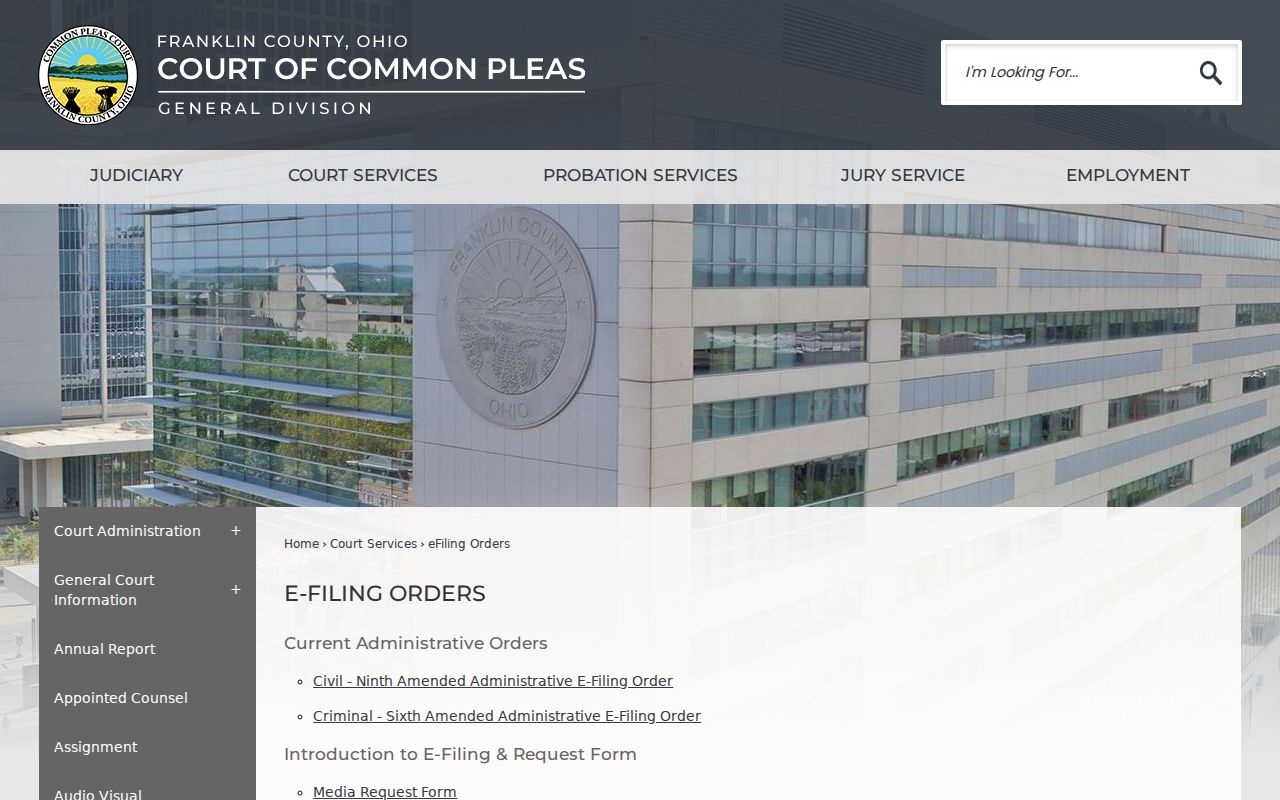
E-filing is now part of the Franklin County General Division docket story. The rollout began in August 2011. Foreclosure filings became mandatory that October 2011. The remaining civil categories joined later that fall. Current Franklin County General Division e-filing orders lay out the electronic case-management and document-management framework, clerk review, electronic service, and how sealed documents are handled conventionally once an order permits it.
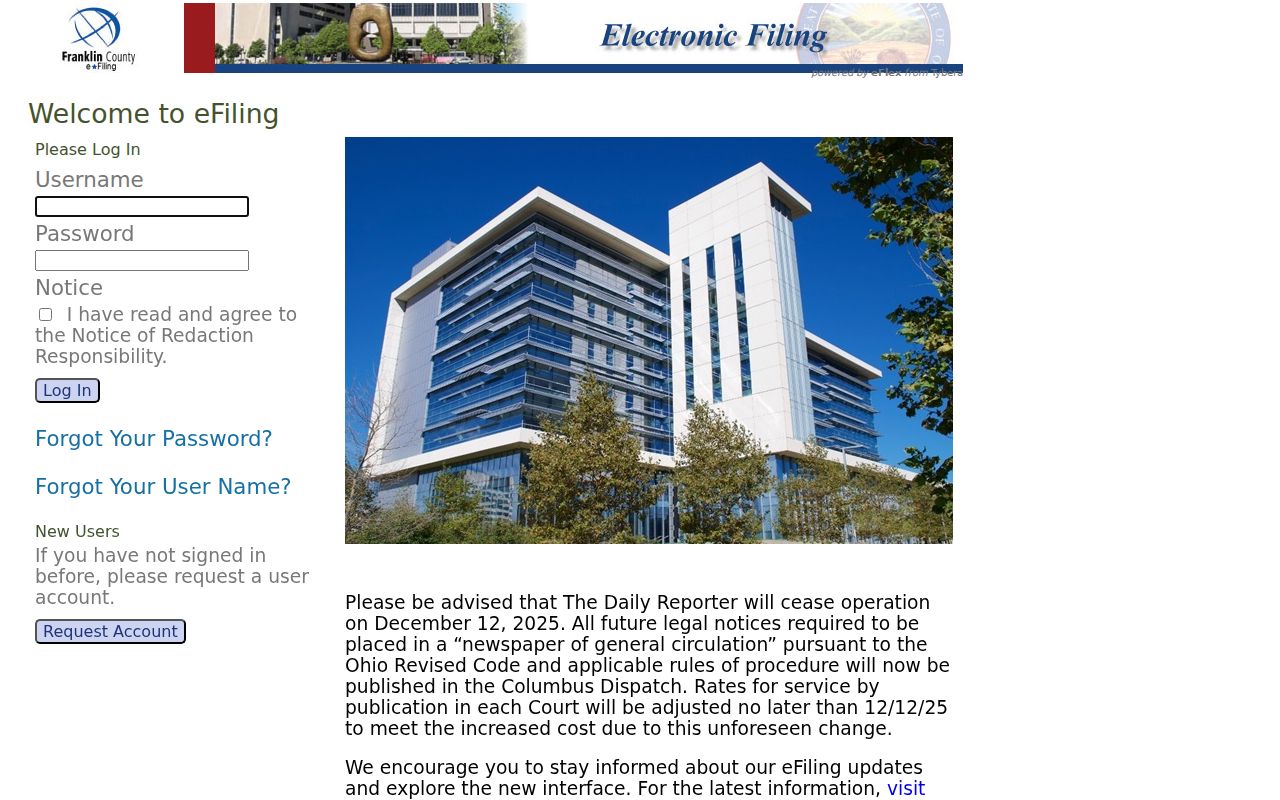
The Franklin County e-Filing / eFlex system is the filing channel. CIO is the reader for accepted public case information. That split matters in practice. A party can submit a document and still see no docket entry until the clerk accepts it. Public computer stations support registration and filing for mandatory filers who lack internet access.
The General Division e-filing materials describe the court’s electronic filing framework.
Note: E-filing sends documents to the court. CIO is where the public reads accepted case information.
Hearings on the Civil Docket
A Franklin County civil docket moves through familiar stages. Papers get filed and served. An answer or motions come next. Then the court sets a hearing, orders mediation, or decides the case. After judgment, execution or an appeal may follow. For a hearing date, trust the docket's current setting above all else. The filing date and the hearing date sit in separate fields. They do different jobs. A hearing date is never the same thing as a filing date.
To confirm a hearing, first pull the court, location, and date from the case. Then check the Franklin County CIO schedule inquiry for Common Pleas calendars. Municipal cases run through Franklin County CASE Network or the right clerk channel. The county Court Schedule page walks through that date-and-location workflow. One caution: an old paper notice can be stale. A later docket entry or court order may have moved the setting.
Franklin County Civil Docket Documents
Think of three separate products here. A docket tells you what happened and when. A filed document is the paper itself. A certified copy carries the clerk's seal for official use. Franklin County CIO or CASE Network helps you pin down the right court and case number first. The Legal Division of the Franklin County Clerk of Courts keeps General Division records on floor 1 at 345 S. High Street. You can call 614-525-3600 for help with case information.
For one specific record, the Clerk's public-record request route is the door to use. Inspection plus copies by mail, email, or fax is handled under the policy where available. Describe what you want clearly; the county weighs response time by volume, storage, and any legal review. Municipal civil records work differently. Use CASE Network to spot the case, then call the Municipal Civil Department at 614-645-7220. Transcripts and depositions are a separate matter. The Clerk's policy sends parties and their representatives back to the original court reporter for that material.
The Clerk’s production e-filing address is the submission channel associated with the civil docket framework.
Note: A Franklin County civil docket search does not guarantee that every filed image is online or that a copy is certified.
Franklin County Civil Docket Requests
Say the docket gives you the case. But the document you need is not in the public view. Then a specific records request is the practical next step. Franklin County Clerk policy allows inspection without a written request. It asks for no ID. It wants no stated reason. Still, a clear case number, the court division, and a plain description of the filing make retrieval much easier.
Timing depends on scope, storage location, and whatever legal review applies. For Common Pleas material, the public-records route can hand you a paper copy, an emailed or faxed copy where available, or a mailed copy with postage. Certified and exemplified copies are separate clerk products. Municipal Court keeps its own records and counter. In short, the Franklin County docket is the locator; the court or clerk holding the file controls inspection and copies.
Who Can See Civil Dockets
Public access is the default for Franklin County court records, though exclusions, sealing orders, and protected information can limit what you see. Under Clerk policy, Common Pleas and Tenth District records in its care stay public unless a statute, a Superintendence Rule, a procedural rule, or a local rule says otherwise. Protected identifiers may be withheld or redacted. One caution: a public docket result locates activity. It is not an official clerk-certified record.
Access rules:
Ohio Sup.R. 44–47 establishes the framework for court-record access and exclusions.
Ohio Revised Code §149.43 addresses inspection and copying of covered public records, with statutory exceptions.
The General Division fee schedule distinguishes paper copies, certified copies, and exemplified copies.
Copies from the General Division carry set fees. Paper pages run $0.10 each. A certified document costs $1. An exemplified document costs $4. Because fees and access rules can change, ask the clerk who keeps the civil docket file before you order anything.
Note: A public docket view, a plain copy, and a certified copy are three different levels of access to court records.