
Columbus Court Docket Searches
For core Columbus cases, there is one main entry point. That is the Franklin County Municipal Court Clerk CASE Network. Columbus runs no separate Mayor's Court here. Everything routes through the countywide Municipal Court database instead. That covers criminal, traffic, civil, environmental, small-claims, and related Municipal Court matters for the city.
The search works best with a case number or ticket number. CASE Network will also take a first-and-last-name combination. A company name works too, as a primary criterion. Have the citation or prior notice in hand before you start. Open the matching Columbus result. Read the case status and current setting. A detail that needs confirmation belongs with the responsible Columbus clerk channel. A missing local matter could sit at another court level. It might also rest at a different city forum or behind a restriction. The court printed on the citation is still the first routing fact.
- Open CASE Network for a Columbus Municipal Court case.
- Enter the Columbus case number or ticket number exactly, including ticket letters.
- Use both first and last name for a Columbus name search when no number is available.
- Read the Columbus case type, status, docket events, and current setting.
- For a local felony or major civil case, continue with CIO after identifying the court.
Note: An online docket helps you locate a Columbus case, but the court clerk keeps the official record.
CASE Network Columbus Court Records
CASE Network is the named Columbus channel for Municipal Court case information. Its search form splits out fields for name, company, case, ticket, year, type, and status. For a Columbus traffic case, a ticket number is especially handy. The Clerk names it as an accepted primary criterion. Optional fields narrow further. Use a middle name, date of birth, party type, or case year.
Results are case information, not a promise that every filing is downloadable. The Municipal Clerk publishes example formats. Each has a year, code, and sequence. Examples include 2027 TR C 123456 for traffic and 2027 CR A 001234 for criminal. Treat those as Columbus Municipal formats only, never a substitute for the citation's actual text. One more caution applies here. An entry marked closed still needs care. The Clerk warns that closed does not necessarily mean completed or adjudicated.
| Columbus search handle | CASE Network use |
|---|---|
| Case number | Primary criterion for a Columbus Municipal case. |
| Ticket number | Primary criterion; include Columbus ticket letters. |
| First and last name | Both are needed for a Columbus name search. |
| Company name | Another primary criterion for a Columbus case. |
| Status and year | Optional limits for broader Columbus results. |
Inside the Columbus Municipal Court
Most Columbus cases live in one place. The Franklin County Municipal Court handles criminal, traffic, civil, environmental, and small-claims matters for Columbus and the rest of Franklin County. The bench holds 15 judges and nine magistrates. The docket is huge. A case number and division will get you further than a guess based on a Columbus address.
The clerk splits its phone lines by subject. Call the one that fits your case. The court sits at 375 S. High Street, Columbus, OH 43215. The main line is 614-645-8214. Criminal and traffic clerk matters go to 614-645-8186. Civil is 614-645-7220, and traffic information is 614-645-8166. The Municipal Clerk contact page lists each department and its channel. That page helps once a CASE Network search has turned up your case.
Want the court's own description of its size and structure? The official Municipal Court overview is the place to look. It also confirms that the court keeps its record system separate from CIO.
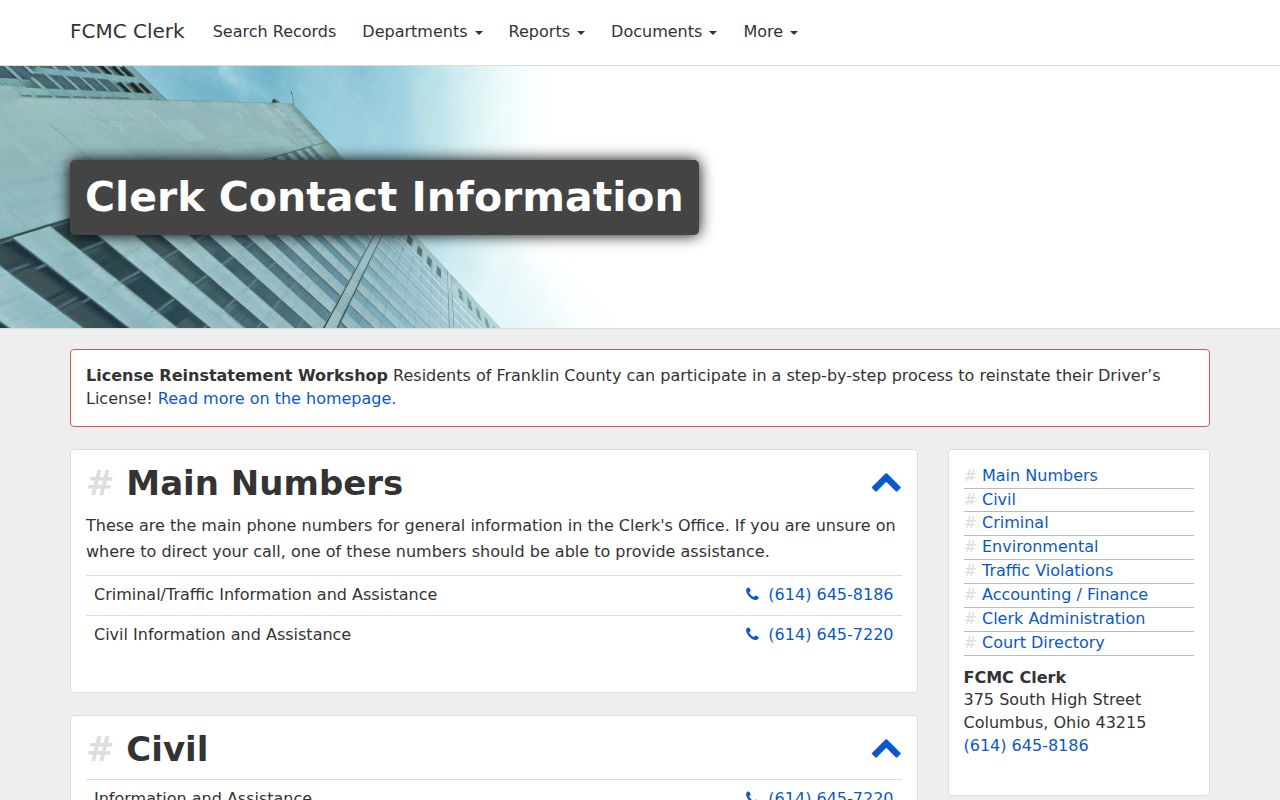
The listed clerk departments tell you which counter or phone route matches the record. Use them to confirm before you travel or call.
Columbus Court Docket Details
Think of a docket entry as a case timeline. It ties together an identifier and the court. The parties, a case category, and docket events appear too. So do current or prior settings, entries or orders, and the disposition. CASE Network exposes more Columbus search handles than a plain name lookup, which makes it easier to follow a case from filing to setting. It is still not the same thing as a certified copy, which only the clerk issues.
For a pending Columbus matter, compare the current setting against the citation or notice. Then call the right clerk line. A case record can change after any search. A public result never replaces a court order. These details carry practical meaning, but the public result does not guarantee every field.
| Case or ticket number | Identifies the Columbus Municipal Court matter. |
|---|---|
| Case type | Distinguishes the Columbus case category. |
| Status | Shows an open or closed concept, subject to the Clerk warning. |
| Docket events | Lists chronological Columbus case activity. |
| Current setting | Shows a Columbus hearing date or time to confirm. |
| Disposition | Records an outcome when the Columbus case has one. |
Finding Columbus Court Dates
Check the case record first for any Columbus court date. CASE Network can carry a user from the case number to pending case information. The Municipal Clerk says dates and times can be determined by the proper case number. Traffic cases add a route through 614-645-8166. Pending Columbus dates can be confirmed at 614-645-8186 with the case number in hand. The citation is an important notice. It does not replace a current court check.
Arraignment locations follow a pattern. Columbus traffic arraignments use room 1A for last names A through K. Names L through Z use 1B. Municipal criminal arraignment reporting splits between 4C and 4D. These labels explain a calendar report, not a reason to guess the present setting. The daily arraignment report directory is organized by date and courtroom. Rely on the linked Columbus case record and clerk confirmation for the current hearing.
Docket flow: Columbus citation or complaint › CASE Network case detail › current setting › Columbus clerk confirmation when needed.
Columbus Traffic Arraignment Records
Columbus traffic cases run through the Municipal Court. The volume is large. Traffic magistrates processed 51,709 cases in courtrooms 1A and 1B, per the 2024 annual report. That figure describes court workload only. It says nothing about any single Columbus case or its outcome. To check a local traffic record, search by ticket number or case number. Then confirm the current setting on that case itself.
The room assignments give arraignments a rough order. Surnames A through K go to room 1A. L through Z go to 1B. Doors for those traffic rooms open at 8:15 a.m. Still, the case detail and the official court notice carry the information that counts. A Columbus hearing should never be assumed from a general schedule.
The official 2024 Municipal Court annual report supplies the Columbus traffic context.
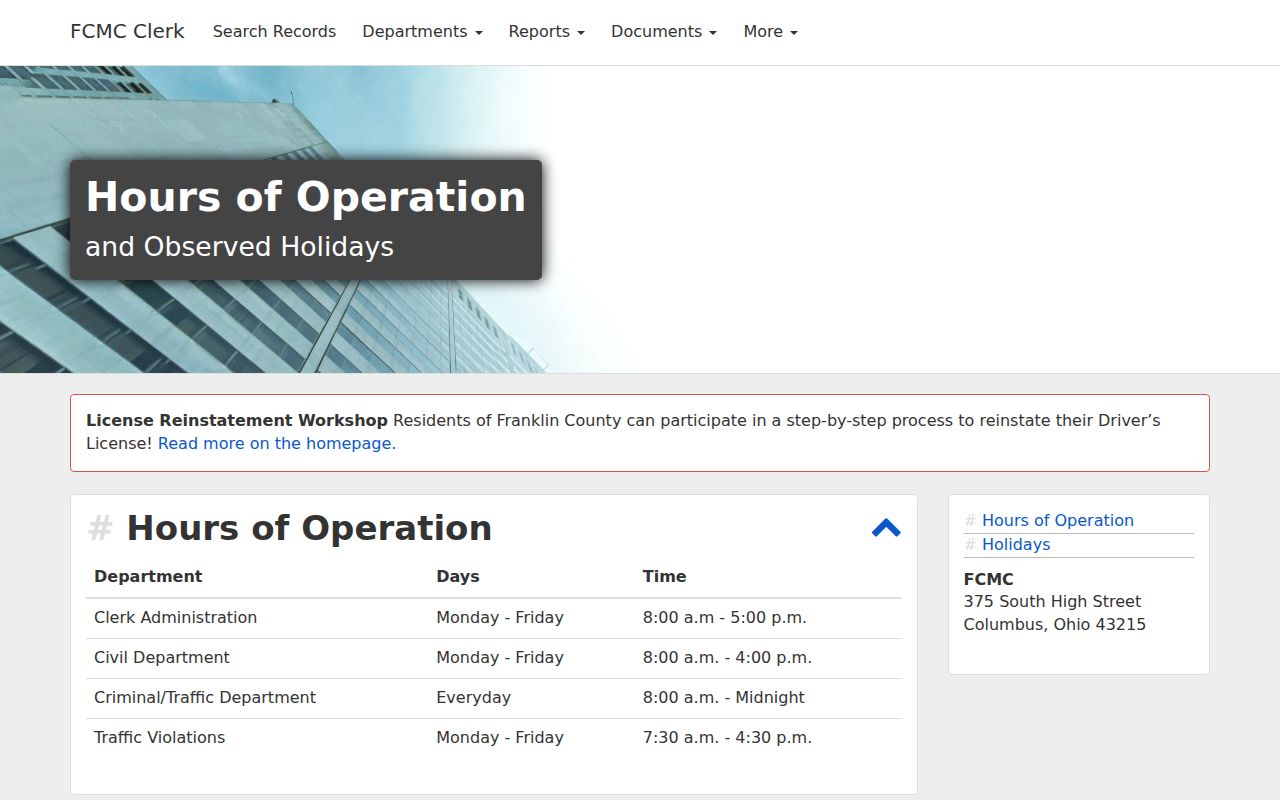
Clerk hours: Columbus office hours help once the case and setting are known, so check the clerk's posted hours before calling.
Columbus Traffic Ticket Lookups
Start with the court printed on the citation. Through the Columbus Municipal Court channel, CASE Network takes a ticket number. The ticket letters must be included. The Municipal Traffic Violations Bureau processes tickets from 21 municipal law-enforcement agencies and eight townships. Columbus police are among them. Mayor's Court transfer cases come through as well. Coverage is countywide. So the issuing court and Columbus case number matter most.
A payable Columbus violation can be paid through the proper court on or before its court date. A contested charge, or one requiring appearance, goes through the court process. The citation date controls the immediate response. The current Columbus docket and the clerk confirm the setting. For transfers or countywide traffic questions, see Franklin County traffic court records.
Columbus Daily Arraignment Records
The Columbus Municipal Clerk publishes daily arraignment reports by date and courtroom. Each report sorts the traffic, criminal, and environmental calendars into groups labeled 1A, 1B, 4C, 4D, and 15A. A report is a calendar aid. It cannot replace the individual case docket or an official court notice.
The labels carry meaning. Columbus 4C marks an out-of-jail criminal or OVI arraignment grouping. The 4D label marks an in-custody criminal or traffic grouping. Pair the report date and courtroom with the Columbus case number. A continuance, changed setting, or court order appears only in the underlying record. Current case detail and the Clerk remain the confirmation path. The official source is the Municipal Clerk daily arraignment directory. A report label is never a final ruling. It does not substitute for a court instruction.
How Columbus Cases Reach the County
Not every Columbus case stays put. Franklin County Municipal judges handle felony arraignments and preliminary proceedings. After indictment, a felony ordinarily moves to the Franklin County Court of Common Pleas. Civil matters that exceed Municipal Court jurisdiction take the county route too. The Franklin County Clerk of Courts keeps those Common Pleas records. It does so through Case Information Online, called CIO. That system is not the Columbus Municipal CASE Network system.
Docket flow: Columbus Municipal Court › Franklin County Municipal preliminary record or local case › Franklin County Court of Common Pleas record in CIO when the Columbus case reaches that level.
For a Columbus felony after indictment, search CIO with the court name and case number. CIO covers Common Pleas General Division civil and criminal cases, Domestic Relations, Juvenile, and Tenth District appeals. An address alone will not pick the right system.
Columbus Municipal and County Records
Two systems, two clerks. CASE Network serves the Columbus Municipal channel. CIO serves Common Pleas and its related county divisions. A Columbus felony can leave an early Municipal record and a later Common Pleas record. Follow the case stage rather than expecting one database to hold everything.
The split matters for records requests. A Municipal case belongs with the Municipal Clerk. A Columbus Common Pleas case belongs with the Franklin County Clerk of Courts. A public court record can be viewed online. It can also be inspected or requested through the right clerk, or ordered as a certified copy when an official form is required.
| Columbus case location | Record route | Reason |
|---|---|---|
| Municipal criminal, traffic, civil, or small claims | CASE Network and Municipal Clerk | Columbus uses the countywide Municipal Court channel. |
| Felony after indictment or major civil matter | CIO and Franklin County Clerk | The Columbus case has reached Common Pleas. |
Who Can See Columbus Court Records
Ohio court-record rules keep Columbus court records generally open, though exclusions and procedures apply. The public Columbus docket helps locate a case, hearing, or filing. Openness has limits, though. Protected personal identifiers, juvenile material, sealed or expunged matters, and other restricted records can all hide parts of a Columbus public search. A docket entry does not make a result certified.
With a known Columbus Municipal file, CASE Network identifies the case or ticket number. The clerk counter handles the rest. So does the phone line or a written public-record request. The Municipal Clerk states its criminal and traffic records are public. It will not run an open-ended Columbus record search by phone. Give the case number. A narrow request works far better than a broad one.
Key Rules:
Ohio Sup.R. 44-47 provides a public-access presumption for court records while recognizing exclusions and procedures.
Ohio Revised Code §149.43 addresses inspection and copying of covered public records, with statutory exceptions.
Ohio Revised Code §2953.32 governs sealing or expungement for qualifying conviction or bail-forfeiture records.
Columbus Court Record Limits
A blank result in a Columbus docket search does not mean no case exists. The miss can have many causes. Maybe the name search hit the wrong court channel. Or the filing is too new to show yet. Some cases move up to Common Pleas, and some case types are restricted. A sealing or expungement can also block the record. So treat an empty result as a routing problem, not a verdict, and ask the clerk who holds the file which channel covers a known case.
Access and certification are different things, too. An online Columbus docket shows events and an index. The actual document sits in the court file. Only a certified copy from the clerk counts as an official one. For Columbus Municipal cases, the CASE Network case number is the place to start, followed by the clerk channel for that division. In Common Pleas, CIO can pin down the Columbus case before you make a focused request.
Scale matters here. The 2020 Census put Columbus at 905,748 residents. That is why exact routing and identifiers save so much time. The official Census QuickFacts source gives that population figure in full.
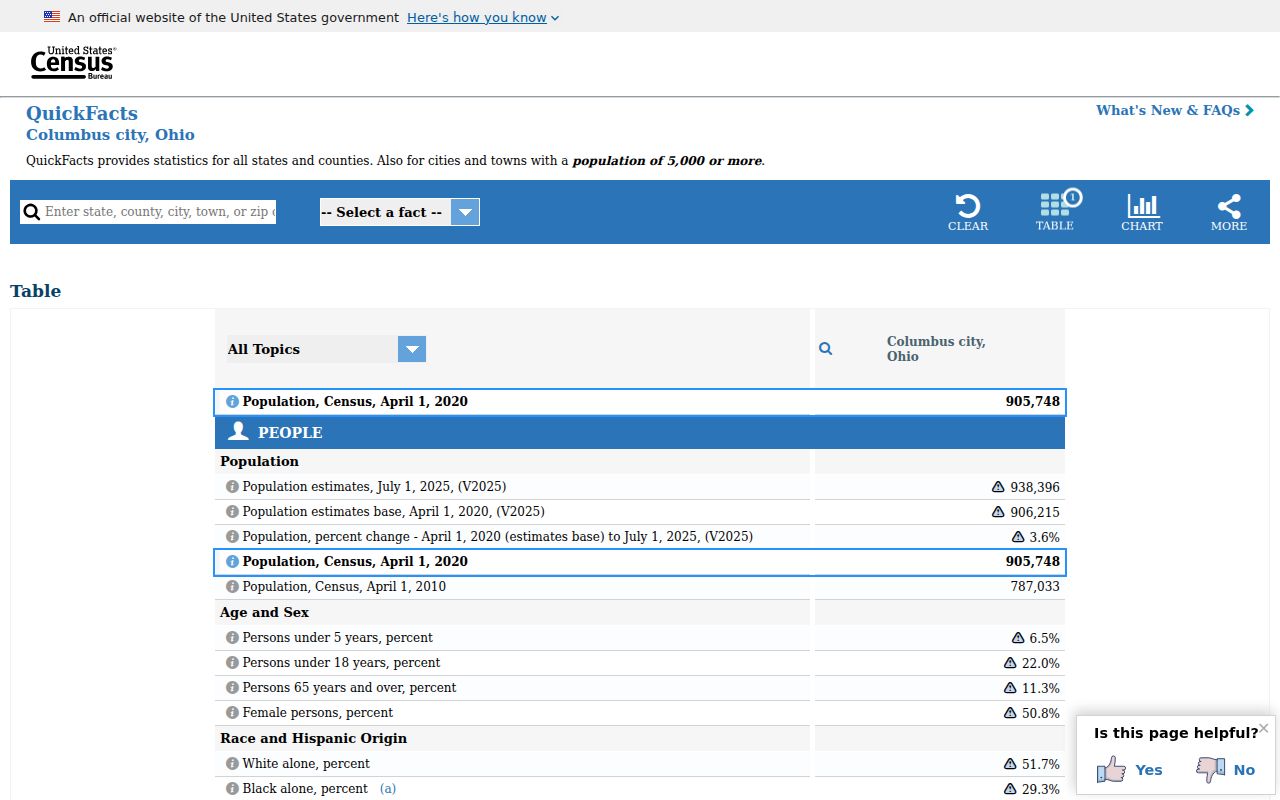
Size is no excuse for guesswork. Every Columbus court record still turns on the right court and the right case identifier.