
Franklin County Court Docket Searches
Franklin County splits its court records across several systems, so no single search covers everything. Your first move is simple. Match the court named on your citation, summons, complaint, notice, or prior entry. The Franklin County Clerk of Courts runs Case Information Online, or CIO. It serves Common Pleas General Division, Domestic Relations, Juvenile, and Tenth District appeals. The Municipal Court Clerk keeps a separate tool. It is called CASE Network. Probate offers its own General Case Index. And a citation from a city may belong to a Franklin County Mayor's Court instead.
Exact numbers make any Franklin County docket search far more reliable. CIO builds a case number from a year, a type code, and a sequence. Municipal Court numbers combine a year, a three-letter code, and a six-digit sequence. The court named on the paperwork matters. So does the city where the event took place.
- Read the issuing Franklin County court and case or ticket number on the most recent court paper.
- Use CIO for Franklin County Common Pleas-related cases, CASE Network for Franklin County Municipal Court, Franklin County Probate's index for Probate, or the Franklin County city court's portal for a Mayor's Court matter.
- Search by the exact number first. If that is not available, use the name fields and Franklin County court filters.
- Open the matching Franklin County docket and compare its newest setting or entry with the notice in hand.
- Use the responsible Franklin County clerk's counter, phone line, or records-request route when a result is missing, newly filed, older, or restricted.
Franklin County's Four Docket Systems
The most common routing error in Franklin County is treating every case as if it lives in one database. It does not. CIO covers only the Clerk-managed Common Pleas divisions and appeals. CASE Network handles Municipal Court civil, criminal, traffic, environmental, small-claims, and eviction dockets. Probate keeps a separate index. Participating cities run their own Mayor's Court channels. A Franklin County felony can start in Municipal Court before landing in Common Pleas after indictment.
| Franklin County system | Best Franklin County use | Useful fallback |
|---|---|---|
| Franklin County CIO | Common Pleas, Domestic, Juvenile, appeals | Franklin County Clerk Legal Division |
| CASE Network | Franklin County Municipal civil, criminal, traffic, eviction | Franklin County Municipal Clerk department |
| Franklin County Probate Index | Estates, guardianships, name changes | Franklin County Probate Certified Records |
| Mayor's Court portal | Franklin County city ordinance and qualifying traffic matters | Local court clerk |
Sorting out which Franklin County court holds your case saves real time. The Municipal Court, the Common Pleas divisions, and the city courts each follow different routes. Try a name-only search in the wrong system. It rarely goes anywhere useful. The Franklin County Municipal Court's official overview identifies the court and spells out the kinds of cases it hears.
The Municipal Court runs its own clerk operation entirely. That independence is exactly why CASE Network stands apart as a distinct Franklin County docket route.
Court Dockets: What They Show
A docket is the timeline of a Franklin County case. It is not a certified record by default. Nor does it promise that every filing image appears online. These public systems help you spot key pieces. They include the court, the case number, the category, the events, and the settings. Exact fields vary from one system to the next. CIO exposes the division and the case-number pieces. CASE Network adds filters such as case status, ticket number, party type, and case year.
| Case number | Identifies the court's file. CIO combines year, type, and sequence, such as 2026 CR 0123456. |
|---|---|
| Case category | Routes the matter, such as CIO CR for criminal or CV for civil. |
| Entries and filings | Show dated court activity; a public entry is not the same as a certified copy. |
| Setting | Shows the current or prior hearing date, time, court, or location when available. |
| Disposition | Records a case outcome using the court's own language. |
Franklin County Court Docket Codes
The case-type selector on CIO works like a map for a Franklin County Common Pleas search. Each code narrows the field. CR covers criminal cases, CV civil, and AP appeals. Domestic matters split by code: DM marks dissolution and DR marks divorce. EP is the expungement code. EX stands for execution, JG for judgment, LP for lis pendens, and MS for miscellaneous. The code helps you sort a Franklin County court docket search when you already hold a case number, but it cannot replace opening the case itself and reading the entries.
- CIO
- The Franklin County Clerk's public Case Information Online reader for the listed Franklin County Common Pleas divisions and appeals.
- Case type
- The Franklin County court-specific category used within a case-number format.
- Case Summary
- Franklin County Probate's local label for its public case-detail and document-view route.
- Closed status
- A Franklin County Municipal CASE Network filter that does not necessarily mean every question in the matter is complete.
Trust the labels CIO actually displays instead of guessing at abbreviations it does not define. The Advanced Search page gives you more ways to narrow a Franklin County docket search too, including party and attorney fields, filed-from and filed-to date boxes, and controls that limit how many records return.
Franklin County Courts and Their Dockets
Jurisdiction, not convenience, decides where a Franklin County case record lives. Felonies and civil disputes above $15,000 belong to the Common Pleas General Division. Franklin County Municipal Court takes misdemeanors. It also handles preliminary felony proceedings, traffic cases, civil claims up to $15,000, small claims up to $6,000, and environmental matters. Probate sits inside Common Pleas. It is a division of its own, and its records follow a separate search route. The Tenth District appeal record rounds out the picture. For Franklin County, it sits inside CIO.
| Franklin County court or division | Franklin County docket covers | Where to start |
|---|---|---|
| Franklin County Common Pleas General Division | Franklin County felonies and major civil cases | CIO |
| Franklin County Domestic Relations/Juvenile | Franklin County domestic and juvenile matters subject to access limits | CIO and the division clerk |
| Franklin County Probate | Estates, guardianships, adoptions, related probate matters | Franklin County Probate General Case Index |
| Franklin County Municipal Court | Traffic, misdemeanors, municipal civil, small claims, environmental | CASE Network |
Why Franklin County Felony Dockets Split
One felony, two dockets. A Franklin County felony often leaves a trail in both court systems. Municipal Court handles the arraignment and the preliminary phase first. Once an indictment lands, the case usually moves up to the Common Pleas General Division. CIO becomes the public route for a docket search. So a result missing from one Franklin County system may simply mean the case changed court level. It has not vanished.
Franklin County Municipal arraignments are grouped by courtroom, and the daily reports show which. Courtroom 4C lists out-of-jail criminal and OVI arraignments. Courtroom 4D covers in-custody criminal and traffic arraignments. Treat the daily report as a locator only. A later setting rests with the court, not the list.
Court Dates and Settings in Franklin County
Need a Franklin County hearing date? Start with the newest docket entry or order on the case. CIO also offers a separate Court Schedule Inquiry, where you can search a Franklin County Common Pleas date by Court, Location, and an optional Time. Municipal Court cases show up through CASE Network instead. For arraignments, the Franklin County Municipal Clerk posts daily arraignment reports. They are sorted by date and courtroom. Probate and each Franklin County Mayor's Court run their own case and calendar tools. Check those offices directly.
Treat the docket as the starting point, not the last word. When a setting is close, has moved, or seems unclear, compare it against the schedule tool. Confirm with the court or clerk. One caution: a clerk cannot reschedule a Franklin County Municipal hearing over the telephone. The Franklin County court schedule page walks through the fuller date workflow.
Franklin County Court Docket Schedule Inquiry
CIO's Court Schedule Inquiry asks for Court Date, Court, and Location. Time is optional. It works best once you already know the division and setting details from the case. The Location list uses coded courtroom values. Treat any Franklin County result as a lead, not an order. Check it against the case docket and confirm with the responsible court.
Municipal Court's official answers about court dates point readers to the case record and the clerk. That is where case-specific confirmation happens. That step matters. A missed court date can bring court action, including a warrant in an individual matter.
Municipal Court's own date guidance backs up the practical rule. Pair a Franklin County docket with the court's confirmation channel before you rely on either one alone.
Franklin County Court Docket Arraignment Reports
The Municipal Clerk publishes a daily arraignment report directory, a calendar channel of its own. Traffic arraignments split by name. Courtroom 1A takes last names A through K, and 1B takes L through Z. The reports also name the criminal and environmental courtrooms. They help you find the published arraignment session. A current setting for one person still belongs to the case record and the clerk.
Volume explains the need for care. The court's 2024 report lists 51,709 traffic cases handled by traffic magistrates in courtrooms 1A and 1B. That figure describes court operations, not any single case.
Docket Access Under Ohio Law
Ohio's court-record rules presume Franklin County court records are open. Exclusions, court orders, and confidentiality laws still apply. The Clerk's policy puts it plainly: records are public unless an exception applies. It also states that protected identifiers are not knowingly published. A web search can help you spot a case. Need a certified record, a withheld item, or a specific file? Go to the clerk who keeps it.
Key Rules:
Ohio Sup.R. 44-47 explains public access to court records and its exclusions.
Ohio Revised Code §149.43 addresses public-record inspection and copying by public offices.
Ohio Revised Code §2953.32 governs specified sealing and expungement procedures.
Ohio Revised Code §2151.14 makes juvenile probation records confidential except as its law allows.
Some material may never surface in ordinary Franklin County results. Sealed, expunged, juvenile, adoption, mental-illness, and protected-identifier records fall in that group. A no-result can also mean the wrong court, a new filing, maintenance, or an older record.
Franklin County Court Record Copy Routes
A docket view, a filed document, and a certified copy are three different things. CIO and CASE Network locate cases. The Franklin County Clerk's Legal Division serves Common Pleas General Division civil, criminal, and record needs, while Municipal Court and Probate run their own records channels. Say what you want when you ask. Name the case, the division, and the document.
| General Division item | Published amount |
|---|---|
| Paper copy | $0.10 per page |
| Certified copy | $1 per document |
| Exemplified copy | $4 per document |
| Email or fax public-record copy | No charge under the Clerk policy |
The Clerk's annual-report material provides records-management context.
The Clerk's records-management material shows why a Franklin County portal search should end at the clerk. That applies when an official or historical record is needed.
Several routes work. You can use the Clerk's web or written public-record route, visit the counter, or mail a request with the applicable copy and postage cost. You can also call to find the right division. No written form or stated purpose is required. A case number, court, document description, and date range make a Franklin County request far easier to fill. Email or fax copies carry no charge where the Clerk can provide them. Mailed material costs actual postage and supplies.
Municipal Court keeps its own public-record policy and will not run an open-ended records search by telephone. A substantial Municipal search should be mailed or sent to a supervisor. Transcripts and depositions go back to the original court reporter, per the Clerk policy. Juvenile requests follow the documented exception: the requester must appear at the Juvenile Division's counter with valid photo identification, not the general web request route.
How the Clerk Keeps Docket Records
The elected Franklin County Clerk of Courts keeps the files for Common Pleas General Division, Domestic Relations, Juvenile, and the Tenth District. Each division has its own access point. The public-record policy permits an oral request and never forces you to reveal an intended use. A focused description still helps retrieval. Juvenile records are the stated exception to the online web-form path. They require an in-person visit with photo identification.
Franklin County Clerk Legal Division
345 S. High Street, floor 1
Columbus, OH 43215
614-525-3600
Franklin County Clerk of Courts
The Franklin County Clerk's official home page lists its public service links.
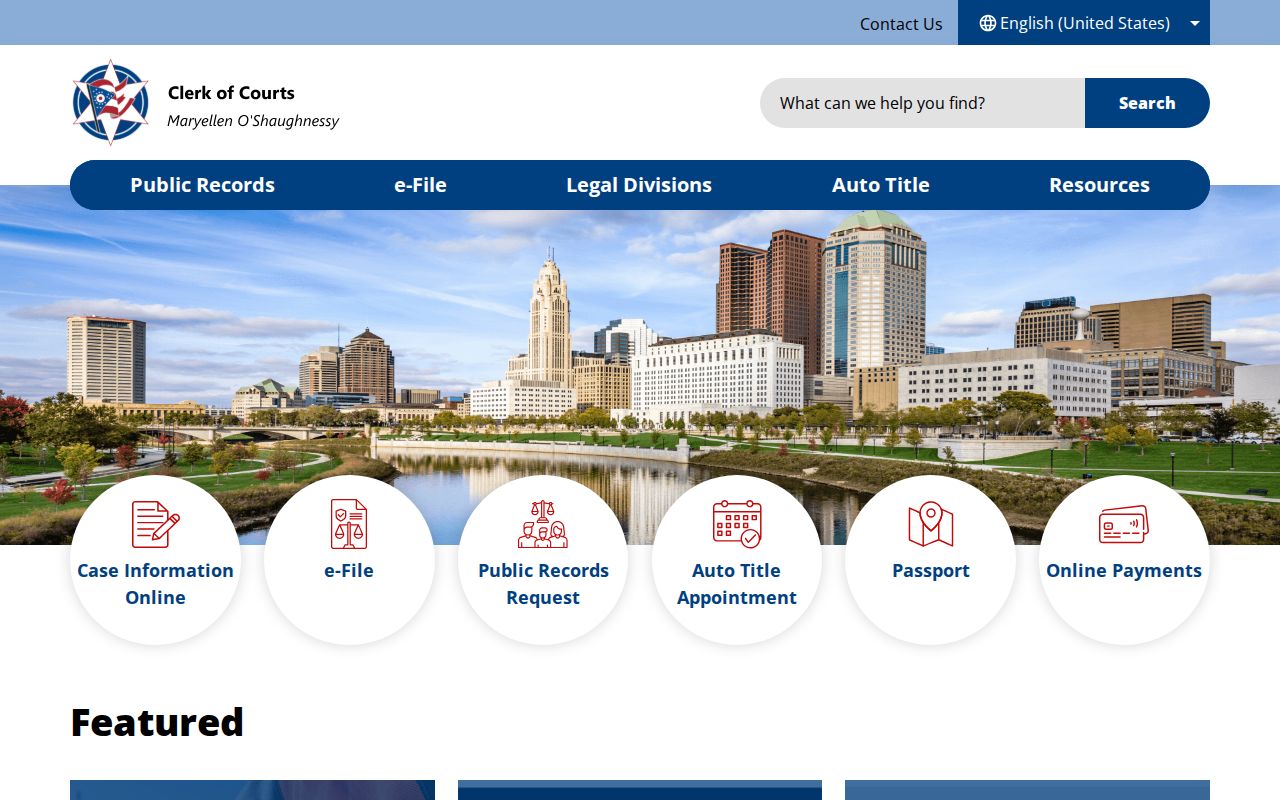
The Clerk's official landing page links CIO, e-filing, records requests, and other Franklin County court services. Municipal and Probate records stay on separate channels.
Franklin County Court Docket E-Filing
Franklin County e-Filing/eFlex is the filing channel, not the public docket reader. General Division's documented transition to e-filing began in 2011. Civil categories were added in phases. The order describes clerk review before anything is accepted into the court's electronic systems. A document uploaded through e-filing is not automatically a public docket item in that moment.
That distinction helps when a search looks incomplete. CIO remains the public case-information reader. Certified copies and restricted material follow the responsible clerk's procedures. The order also provides public computer stations for e-filing registration and filing. Those stations serve mandatory e-file filers who lack internet access.
The Court of Common Pleas home page routes visitors to current court services.
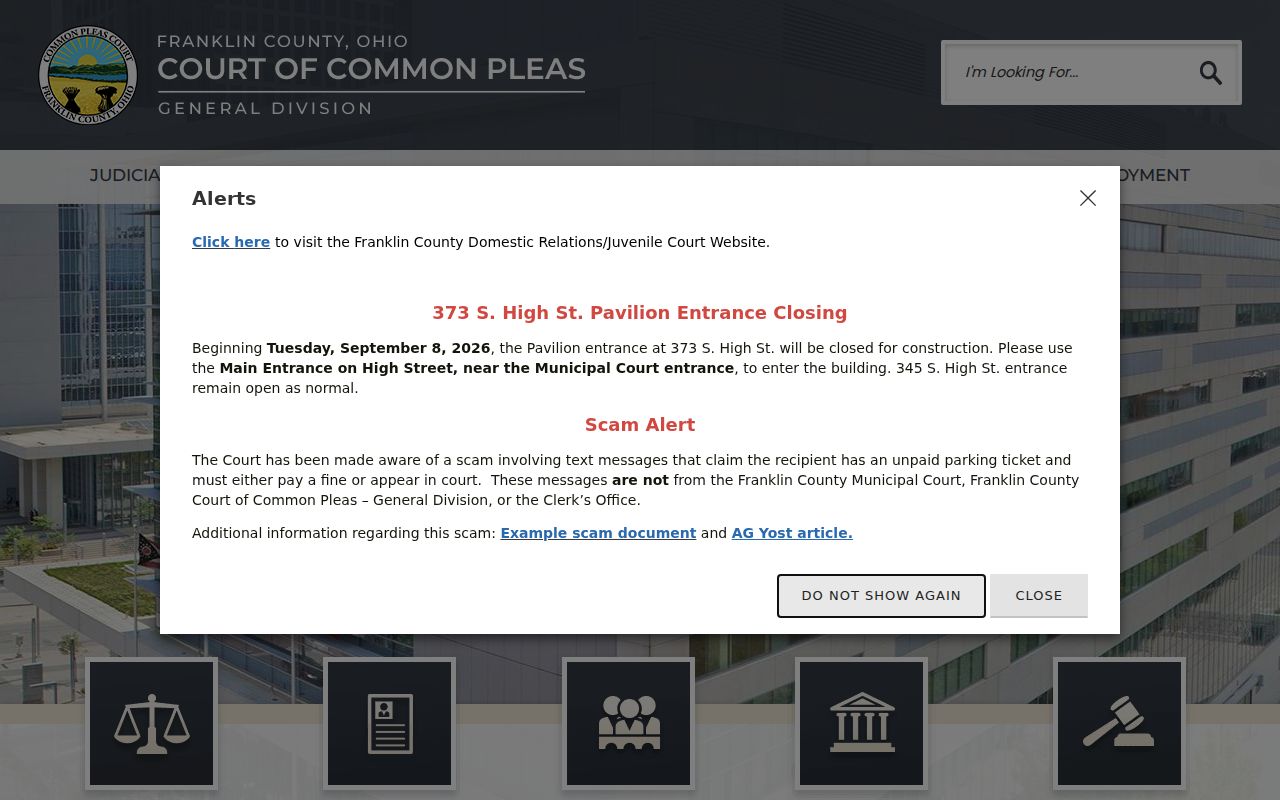
The Common Pleas court sends case searchers to CIO. Filing and records functions stay with its court and Clerk channels.
Franklin County Probate Court Docket Index
Not every Franklin County docket lives in CIO. Probate runs its own General Case Index, built on a six-digit case number plus a suffix. Want detail on a case? The court calls that public view a Case Summary. Results run current through the prior day, not in real time, and weekday backup can block access between 10 p.m. and 2 a.m.
Older Probate files are a different job. The Certified Records desk may pull hard copy, microfilm, microfiche, or electronic images, depending on the record and the access rule that applies. Filings received on or after August 2, 1998 generally have electronic images available.
Franklin County Court Docket Access Changes
Court routes shift. Maintenance windows affect access. Local rule updates do too. Downtown construction plays its part as well, and all of it shapes how a Franklin County court record gets reached right now. In 2026, the Clerk posted CIO and e-filing maintenance notices. Municipal Court, meanwhile, posted government-complex construction updates. Fixed parking or access instructions go stale fast. Live notices from the court and clerk are the better bet. The Municipal Court's July 16, 2026 revised-schedule notice shows exactly what that looks like in practice.
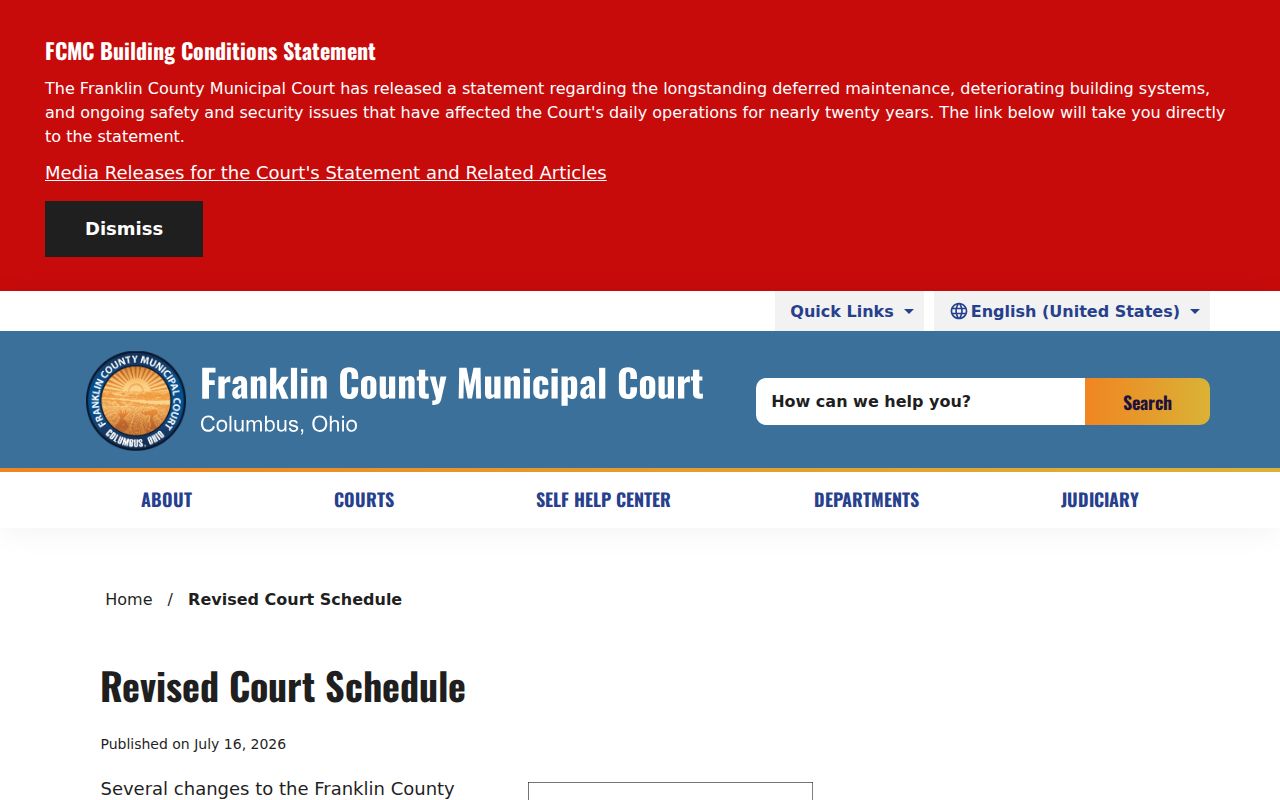
Local schedule and cost changes touch any Franklin County court record. Current Municipal Court notices are the place to check for both.
City-by-City Court Dockets in Franklin County
Columbus channels its core city matters through Franklin County Municipal Court. Dublin, Reynoldsburg, Westerville, and Hilliard each keep a Mayor's Court route for qualifying city cases. Those city pages start local. Then they explain when a case belongs in a Franklin County court channel instead. One fact drives the routing. The issuing court named on the citation tells you which docket holds the case. The city mailing address does not.
Columbus Court Records
Population 905,748, 2020 Census. Municipal Court CASE Network is the core route.
Dublin Court Records
Population 49,328, 2020 Census. Dublin Mayor's Court has its own portal.
Reynoldsburg Court Records
Population 41,076, 2020 Census. CourtView handles local case access.
Westerville Court Records
Population 39,190, 2020 Census. The Justice Center serves Mayor's Court.
Hilliard Court Records
Population 37,114, 2020 Census. A city-authorized docket portal is available.
Map and Directions to the Franklin County Courthouse
The General Division of the Franklin County Court of Common Pleas sits at 345 S. High Street in downtown Columbus, with the Clerk's Legal Division for civil, criminal, and records work on the first floor. Domestic Relations, Juvenile, Probate, and the Tenth District Court of Appeals are a block away at 373 S. High Street, and Franklin County Municipal Court and its Clerk occupy a separate building at 375 S. High Street. High Street construction has periodically changed pedestrian routes near these buildings, so check the Clerk's or Municipal Court's live notices before a visit.
Franklin County Clerk Legal Division
345 S. High Street, floor 1
Columbus, OH 43215
614-525-3600
Monday through Friday, 8:00 a.m. to 5:00 p.m.
Franklin County Municipal Court's departments keep different hours in their own building: Civil runs 8 a.m. to 4 p.m. weekdays, Criminal/Traffic runs 8 a.m. to midnight daily, and Traffic Violations runs 7:30 a.m. to 4:30 p.m. weekdays. No official source describes a single visitor-security or parking policy covering all four downtown court buildings, so confirm current access with the specific clerk before a trip.